Tag: DevOps culture

  • Fundamental Concepts & First Principles of DevOps

    DevOps is not just a toolset — it’s a mindset and a business advantage.Its purpose is simple. we will see the Fundamental Concepts & First Principles of DevOps.

    To understand deeply, we must start from its first principles — also known as The Three Ways.


    The Three Ways of DevOps (Core First Principles)

    1. Flow — The First Way

    Increase the speed of work moving from Development → Operations → Customers.

    How?

    • Systems Thinking: Analyze the entire value stream end-to-end
    • CI/CD: Automate build → test → release
    • Reduce handoffs, remove bottlenecks

    Goal → Deliver updates faster and with higher quality


    2. Feedback — The Second Way

    Create fast and continuous feedback loops.

    How?

    • Real-time monitoring + logging
    • Shift-Left: testing and security earlier in lifecycle
    • Quick detection → quick correction

    Goal → Fix issues before customers notice


    3. Continuous Learning & Experimentation — The Third Way

    Build a blameless, innovative culture.

    How?

    • Learn from failures, not punish them
    • Encourage experiments, small frequent changes
    • Apply Lean principle → Kaizen (continuous improvement)

    Goal → Organization keeps improving forever


    Culture + Process + Technology

    ValueMeaning
    Shared ResponsibilityDev & Ops accountable together
    Collaboration & EmpathyRemove silos
    Psychological SafetyFailures = learning
    Product ThinkingFocus on customer value

    Technical Foundations You Must Master

    ConceptWhy It Matters
    AutomationRemove slow manual tasks
    Infrastructure as CodeReproducible, versioned environments
    Version ControlTrack every change (Git is essential)
    ObservabilityKnow what’s happening in production
    Security IntegrationDevSecOps ensures safety by design

    DevOps Core Knowledge Areas (Skill Map)

    PhaseWhat to LearnKey Tools
    FoundationsLinux, Git, Networking, ScriptingBash, Python
    Automation & CI/CDBuild & test automationGitHub Actions, Jenkins, GitLab CI
    Infrastructure & OrchestrationContainers, IaC, cloud infraDocker, Kubernetes, Terraform, Ansible
    Cloud & ObservabilityMonitoring, logs, tracingAWS/GCP/Azure, Prometheus, Grafana, ELK

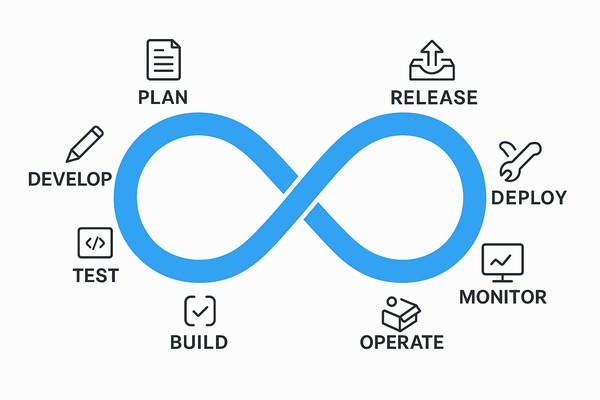
    DevOps Lifecycle Summary (Infinite Loop)

    This loop emphasizes:
    Continuous flow
    Continuous improvement
    Continuous feedback


    Real-World DevOps Example (Short & Clear)

    StageAction
    CodeDeveloper pushes code to GitHub
    Build & TestCI pipeline automates code compilation + testing
    DeployCD pipeline deploys app to Kubernetes
    MonitorLogging + metrics detect issues instantly
    ImproveFix fast → redeploy safely

    That’s the heart of DevOps.


    Reality DevOps Interview Questions + Best Answers

    Here are 8 practical interview-quality Q&A you can publish:


    Q1: Why do companies adopt DevOps?

    Answer:
    To increase delivery speed, reduce failures, improve reliability, and deliver maximum business value continuously.
    Dev + Ops → one single delivery team instead of silos.


    Q2: Difference between CI and CD?

    CI (Continuous Integration)CD (Continuous Delivery/Deployment)
    Code merged frequently + auto testsCode auto-released to staging/production
    Improves code qualityImproves release speed & reliability

    Q3: What does “Shift Left” mean?

    Move security and testing earlier in the pipeline so issues are caught before production.


    Q4: What problem does IaC solve?

    Removes manual configuration
    Ensures repeatable deployments
    Enables version-controlled infrastructure

    Tools: Terraform, CloudFormation, Ansible, Pulumi


    Q5: DevOps vs SRE?

    DevOpsSRE
    Culture + practicesEngineering discipline implementation
    Focus on delivery processFocus on reliability with SLIs/SLOs

    Both complement each other.


    Q6: What is Observability?

    Knowing the internal state of a system by analyzing:

    • Logs
    • Metrics
    • Traces
      Helps predict issues before failures.

    Q7: What is “Blameless Post-Mortem”?

    Instead of blaming individuals for outages, analyze process or system failures → improve continuously.


    Q8: Is DevOps a Tool or a Role?

    DevOps is primarily a culture & set of practices.
    Tools help execute that philosophy.

    Next Steps :

  • DevOps vs SRE differences and when to use each

    DevOps and Site Reliability Engineering (SRE) have overlapping goals but differ significantly in focus, responsibilities, and approaches. we will see DevOps vs SRE differences in this article.

    Key Differences

    Focus:

    • DevOps focuses on the entire software development lifecycle, emphasizing collaboration between development and operations to deliver features quickly and reliably.
    • SRE focuses narrowly on system reliability, scalability, and stability in production, ensuring that changes do not increase failure rates or disrupt user experience.

    Responsibilities:

    • DevOps teams build and deploy new features, streamlining development and deployment pipelines with continuous integration and delivery practices.
    • SRE teams ensure production systems remain highly available and performant, using engineering practices to automate operations, monitor production, and handle incidents proactively.

    Objectives:

    • DevOps aims to accelerate product development and delivery to meet customer needs.
    • SRE aims to maintain service uptime and reliability, often setting and enforcing service-level objectives (SLOs) and error budgets.

    Team Structure:

    • DevOps teams integrate roles across software development and operations.
    • SRE teams consist of engineers skilled in both software and operations, focusing deeply on reliability engineering.

    Approach to Failures:

    • DevOps is more reactive, fixing problems as they appear and focusing on fast delivery.
    • SRE is proactive, analyzing root causes, performing chaos engineering, and preventing failures before they occur.

    When to Use Each

    • Use DevOps when you want to improve collaboration between development and operations, speed up software delivery, and implement continuous integration/delivery pipelines.
    • Use SRE when your priority is to maintain high reliability and availability of systems at scale, reduce downtime, and manage operational risk through data-driven reliability engineering practices.

    Main Differences: DevOps vs SRE

    FeatureDevOpsSRE
    Primary GoalSpeed & DeliveryReliability & Stability
    Main FocusEntire SDLC (plan → deploy)Production systems
    Mindset“Move fast”“Don’t break things”
    Approach to IssuesReactive + Continuous improvementProactive + Automated
    Key MetricsDeployment frequency, delivery timeUptime, error rate
    Who does it?Developers + Ops teamsSpecialized reliability engineers

    In essence, DevOps defines the broad culture and practices for faster development and deployment, while SRE applies engineering rigor to keep those deployed systems reliable in production. Organizations often integrate both for achieving fast, stable, and scalable software delivery

    Final Thoughts

    DevOps + SRE Better Together

    Here’s the secret:
    Most organizations don’t choose one over the other.

    DevOps = culture + speed
    SRE = discipline + reliability

    Together, they create a balanced system:

    • DevOps pushes updates quickly
    • SRE ensures updates don’t break the system

    Fast + Stable = Happy Users + Happy Business

    Next Steps :

  • Happy Engineers Day to All DevOps Engineers

    Engineers Day is a special occasion to celebrate the brilliance, creativity, and dedication of engineers who shape the world we live in. Today, while we honor all engineers, let’s take a moment to appreciate a unique tribe of engineers who bridge the gap between development and operations – DevOps Engineers.

    Why DevOps Engineers Are Special

    DevOps Engineers are the unsung heroes of the tech world. They ensure that applications are not just built but also delivered, scaled, and maintained efficiently. In a world where software is everywhere, DevOps plays a critical role in:

    • Automation – reducing repetitive manual tasks with CI/CD pipelines.
    • Collaboration – bringing developers and operations teams together.
    • Reliability – ensuring applications run smoothly with monitoring and alerting.
    • Scalability – keeping systems ready to handle millions of users.
    • Innovation – enabling faster delivery of new features.

    Celebrating DevOps on Engineers’ Day

    On this Engineers’ Day, let’s recognize the effort of DevOps professionals who:

    • Stay up late fixing production issues.
    • Automate deployments so businesses can move faster.
    • Secure systems to protect user data.
    • Embrace continuous learning to keep up with cloud-native technologies like Docker, Kubernetes, AWS, Azure, GCP, and more.

    Their contribution goes beyond just coding or server management – they empower businesses to innovate fearlessly.

    A Message to DevOps Engineers

    Dear DevOps Engineers, your role is more than just “engineer.” You are builders, problem-solvers, innovators, and guardians of reliability. On this Engineers’ Day, we celebrate your dedication to creating seamless digital experiences for millions of people worldwide.

    Happy Engineers’ Day to all the amazing DevOps Engineers out there! Keep building, keep innovating, and keep engineering the future.

    Next Steps :

  • What is DevOps?

    In today’s fast-moving world of software, companies need to deliver updates quickly, reliably, and safely. it’s a powerful approach that combines development (Dev) and operations (Ops) to help teams work better together.

    In this blog, we’ll break down what DevOps is, why it matters, and how it’s changing the way software is built and delivered.


    What is DevOps?

    At its core, it is a culture, mindset, and set of practices that bring developers and operations teams together.

    Instead of working in silos — developers writing code, operations managing servers:
    Collaboration
    Communication
    Automation

    With this, teams can build, test, and release software faster and more reliably.


    Why is DevOps Important?

    Here’s why companies adopt DevOps:

    • Faster releases: Deliver new features and updates quickly.
    • Improved collaboration: Break down walls between teams.
    • Higher quality: Automated testing reduces human error.
    • More stability: Better monitoring and rollback tools help maintain uptime.
    • Happier teams: Developers and operations work as partners, not rivals.

    DevOps Tools (A Quick Look)

    There’s no single “DevOps tool,” but here are some popular categories:

    • Version Control: Git, GitHub, GitLab
    • CI/CD: Jenkins, GitHub Actions, GitLab CI
    • Containers: Docker, Kubernetes
    • Configuration Management: Ansible, Chef, Puppet
    • Cloud: AWS, Azure, Google Cloud
    • Monitoring: Prometheus, Grafana, ELK stack

    How Devops Works (Simple Example)

    Imagine you’re building a web app.

    1️⃣ You write code and push it to GitHub.
    2️⃣ A CI/CD pipeline automatically runs tests.
    3️⃣ If tests pass, the app is deployed to a server or cloud.
    4️⃣ Monitoring tools check if everything is working smoothly.
    5️⃣ If something breaks, you get alerts and can quickly fix it.

    All of this happens automatically


    💡 Key Principles

    • Automation: Automate everything from testing to deployment.
    • Continuous Integration (CI): Merge code frequently and test automatically.
    • Continuous Delivery (CD): Deploy updates to users quickly and safely.
    • Collaboration: Developers, testers, operations, and even security work together.
    • Monitoring: Watch systems in real time to catch problems early.

    Key Takeaways

    • DevOps is not just tools — it’s a culture and set of practices.
    • It helps teams work together, automate, and deliver faster.
    • Learning this gives you valuable skills for today’s tech jobs.

    AWS-DEVOPS

    Next Steps