Tag: DevOps skills

  • Fundamental Concepts & First Principles of DevOps

    DevOps is not just a toolset — it’s a mindset and a business advantage.Its purpose is simple. we will see the Fundamental Concepts & First Principles of DevOps.

    To understand deeply, we must start from its first principles — also known as The Three Ways.


    The Three Ways of DevOps (Core First Principles)

    1. Flow — The First Way

    Increase the speed of work moving from Development → Operations → Customers.

    How?

    • Systems Thinking: Analyze the entire value stream end-to-end
    • CI/CD: Automate build → test → release
    • Reduce handoffs, remove bottlenecks

    Goal → Deliver updates faster and with higher quality


    2. Feedback — The Second Way

    Create fast and continuous feedback loops.

    How?

    • Real-time monitoring + logging
    • Shift-Left: testing and security earlier in lifecycle
    • Quick detection → quick correction

    Goal → Fix issues before customers notice


    3. Continuous Learning & Experimentation — The Third Way

    Build a blameless, innovative culture.

    How?

    • Learn from failures, not punish them
    • Encourage experiments, small frequent changes
    • Apply Lean principle → Kaizen (continuous improvement)

    Goal → Organization keeps improving forever


    Culture + Process + Technology

    ValueMeaning
    Shared ResponsibilityDev & Ops accountable together
    Collaboration & EmpathyRemove silos
    Psychological SafetyFailures = learning
    Product ThinkingFocus on customer value

    Technical Foundations You Must Master

    ConceptWhy It Matters
    AutomationRemove slow manual tasks
    Infrastructure as CodeReproducible, versioned environments
    Version ControlTrack every change (Git is essential)
    ObservabilityKnow what’s happening in production
    Security IntegrationDevSecOps ensures safety by design

    DevOps Core Knowledge Areas (Skill Map)

    PhaseWhat to LearnKey Tools
    FoundationsLinux, Git, Networking, ScriptingBash, Python
    Automation & CI/CDBuild & test automationGitHub Actions, Jenkins, GitLab CI
    Infrastructure & OrchestrationContainers, IaC, cloud infraDocker, Kubernetes, Terraform, Ansible
    Cloud & ObservabilityMonitoring, logs, tracingAWS/GCP/Azure, Prometheus, Grafana, ELK

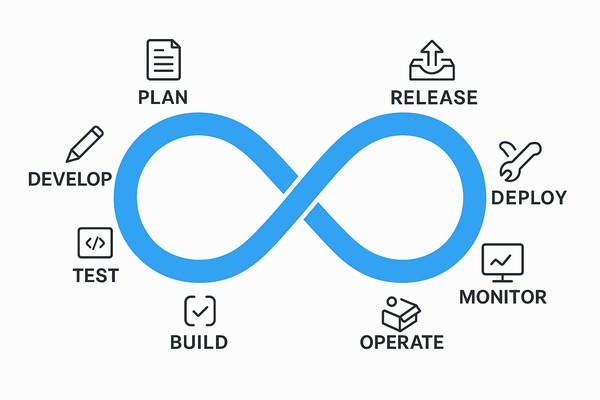
    DevOps Lifecycle Summary (Infinite Loop)

    This loop emphasizes:
    Continuous flow
    Continuous improvement
    Continuous feedback


    Real-World DevOps Example (Short & Clear)

    StageAction
    CodeDeveloper pushes code to GitHub
    Build & TestCI pipeline automates code compilation + testing
    DeployCD pipeline deploys app to Kubernetes
    MonitorLogging + metrics detect issues instantly
    ImproveFix fast → redeploy safely

    That’s the heart of DevOps.


    Reality DevOps Interview Questions + Best Answers

    Here are 8 practical interview-quality Q&A you can publish:


    Q1: Why do companies adopt DevOps?

    Answer:
    To increase delivery speed, reduce failures, improve reliability, and deliver maximum business value continuously.
    Dev + Ops → one single delivery team instead of silos.


    Q2: Difference between CI and CD?

    CI (Continuous Integration)CD (Continuous Delivery/Deployment)
    Code merged frequently + auto testsCode auto-released to staging/production
    Improves code qualityImproves release speed & reliability

    Q3: What does “Shift Left” mean?

    Move security and testing earlier in the pipeline so issues are caught before production.


    Q4: What problem does IaC solve?

    Removes manual configuration
    Ensures repeatable deployments
    Enables version-controlled infrastructure

    Tools: Terraform, CloudFormation, Ansible, Pulumi


    Q5: DevOps vs SRE?

    DevOpsSRE
    Culture + practicesEngineering discipline implementation
    Focus on delivery processFocus on reliability with SLIs/SLOs

    Both complement each other.


    Q6: What is Observability?

    Knowing the internal state of a system by analyzing:

    • Logs
    • Metrics
    • Traces
      Helps predict issues before failures.

    Q7: What is “Blameless Post-Mortem”?

    Instead of blaming individuals for outages, analyze process or system failures → improve continuously.


    Q8: Is DevOps a Tool or a Role?

    DevOps is primarily a culture & set of practices.
    Tools help execute that philosophy.

    Next Steps :

  • How to prioritize which DevOps skills to learn first

    To prioritize which DevOps skills to learn first, focus on building a strong foundation in the core competencies that will enable you to effectively contribute to DevOps processes and projects early on. Here’s a recommended approach

    Step 1: Learn Operating Systems + Scripting

    DevOps runs mostly on Linux — so start here!

    • Learn Linux basics (commands, users, permissions, services)
    • Practice Shell scripting (Bash)
    • Learn Python to automate tasks

    This gives you the power to control systems efficiently and it is must DevOps skills to learn.


    Step 2: Master Git + CI/CD Pipelines

    Version control is required everywhere:

    • Learn Git (branching, merging, GitHub/GitLab)
    • Understand CI/CD concepts
    • Start using tools like:
      • Jenkins
      • GitHub Actions
      • GitLab CI

    This helps automate software delivery.


    Step 3: Infrastructure as Code (IaC) + Configuration Management

    DevOps = automation everywhere.

    • Learn Terraform for provisioning infrastructure
    • Learn Ansible or Puppet to configure servers automatically

    These tools help manage systems at scale.


    Step 4: Containers + Kubernetes

    Most modern apps run in containers.

    • Start with Docker (images, containers, registries)
    • Then learn Kubernetes (pods, deployments, clusters)

    This skill is one of the most important for DevOps jobs in 2025 and beyond.


    Step 5: Monitoring + Logging

    To keep systems healthy, you must track performance:

    Tools to learn:

    • Prometheus (metrics & alerts)
    • Grafana (dashboards)
    • ELK Stack or Splunk (log analysis)

    This helps detect issues before users are impacted.


    Step 6: Networking + Security Basics

    Every DevOps role requires:

    • Basic networking (DNS, firewalls, ports, routing)
    • DevSecOps awareness
    • Security best practices

    Security must be integrated into every step of DevOps.


    Step 7: Soft Skills

    DevOps = collaboration between teams.

    Work on:

    • Communication
    • Teamwork
    • Problem-solving
    • Analytical thinking

    These skills make you stand out.


    Learn Based on Your Career Goals

    If you’re already working in:

    • Cloud environments → Learn AWS/Azure + cloud certifications
    • Development teams → Focus more on CI/CD + automation
    • Operations roles → Start with Linux + IaC + monitoring

    There’s no single right path — choose skills that match your interests.


    Final Thoughts: Keep Learning and Building

    DevOps is a fast-changing world.
    The best way to grow is by practicing:

    Work on labs
    Build real projects
    Contribute to automation
    Experiment with new tools

    Following this roadmap gives you:
    A strong foundation
    Job-ready skills
    Clear path to senior DevOps engineering roles

    Next Steps :

  • Practical Strategies for Implementing DevOps Successfully

    DevOps — it’s more than a buzzword. It promises faster delivery, improved collaboration, better-quality software, and reduced time to market. But for many teams, DevOps remains a lofty goal rather than a practical reality.

    If you’ve ever felt overwhelmed by the countless tools, frameworks, and shifting responsibilities, you’re not alone. The challenge isn’t about lacking resources; it’s about navigating complexity and driving real, sustainable change.

    Instead, start small with a well-defined pilot project that acts as a proving ground.

    How to Do It:

    • Pick a low-risk application — something non-critical where failure won’t be catastrophic.
    • Assemble a cross-functional team — include devs, ops, QA, and product owners to break silos early.
    • Target a specific pain point — slow deployment? Poor feedback loops? Focus on solving one problem with DevOps principles.

    Tip: A successful pilot builds internal case studies, showing real benefits and creating champions for broader adoption.

    Automate, Automate, Automate — But Do It Smartly

    At its core, DevOps is about automation—but not blind automation. The goal is to free your teams from repetitive, error-prone tasks so they can focus on innovation and delivery.

    Key Areas to Automate:

    • Version Control Everything
      Not just code—put infrastructure, config files, and test scripts in Git. IaC (Infrastructure as Code) is non-negotiable.
    • Build CI/CD Pipelines
      Implement Continuous Integration and Continuous Delivery using tools like Jenkins, GitLab CI/CD, GitHub Actions, or Azure DevOps.
    • Automate Testing
      Include unit, integration, and performance tests in your pipeline to catch bugs early.
    • Automate Infrastructure Provisioning
      Use tools like Terraform, Ansible, or Pulumi to provision environments consistently and reproducibly.

    Start small: Automate the most time-consuming or failure-prone manual processes first.

    Foster a Culture of Collaboration and Shared Responsibility

    DevOps isn’t just about tools—it’s a cultural transformation. The hardest part of DevOps is often human, not technical.

    Culture Hacks for DevOps Success:

    • Blameless Postmortems
      Focus on learning, not blaming. Encourage transparency after incidents.
    • Shared Goals & Metrics
      Developers and Ops should align around KPIs like uptime, lead time, and incident recovery rate.
    • Cross-Training
      Let developers understand infra, and ops understand code. Hold regular internal workshops and pair programming sessions.
    • Feedback Loops
      Build systems where teams get real-time feedback on how code performs in production.

    DevOps thrives when teams own the entire lifecycle—from development to deployment to operations.

    Prioritize Observability: Monitoring and Logging from Day One

    You can’t fix what you can’t see. Without visibility, DevOps collapses into guesswork. Robust monitoring and logging are essential for healthy operations.

    Observability Essentials:

    • Centralized Logging
      Use tools like the ELK Stack, Splunk, or Datadog to aggregate logs for fast troubleshooting.
    • Monitoring Key Metrics
      Watch CPU, memory, disk I/O, application latency, and user behavior.
    • Set Up Alerts
      Configure smart alerts to detect anomalies before users do.
    • Distributed Tracing
      Especially in microservices, tracing tools like Jaeger, Zipkin, or OpenTelemetry help track issues across services.

    From Day 1, embed observability into your workflows to shift from reactive firefighting to proactive problem-solving.

    DevOps Is a Journey, Not a Destination

    DevOps isn’t a one-and-done transformation. It’s a continuous improvement mindset. It requires:

    • Technical excellence
    • Collaborative culture
    • Data-driven decision-making
    • A willingness to adapt

    By starting small, automating smartly, fostering collaboration, and prioritizing observability, your organization can move beyond the hype and start realizing DevOps’ full potential—delivering high-quality software quickly, safely, and at scale.

    What’s Your DevOps Challenge?

    Are you struggling with automation, culture, tooling, or something else?

    Leave a comment below — let’s make DevOps simpler, together.

    Next Steps

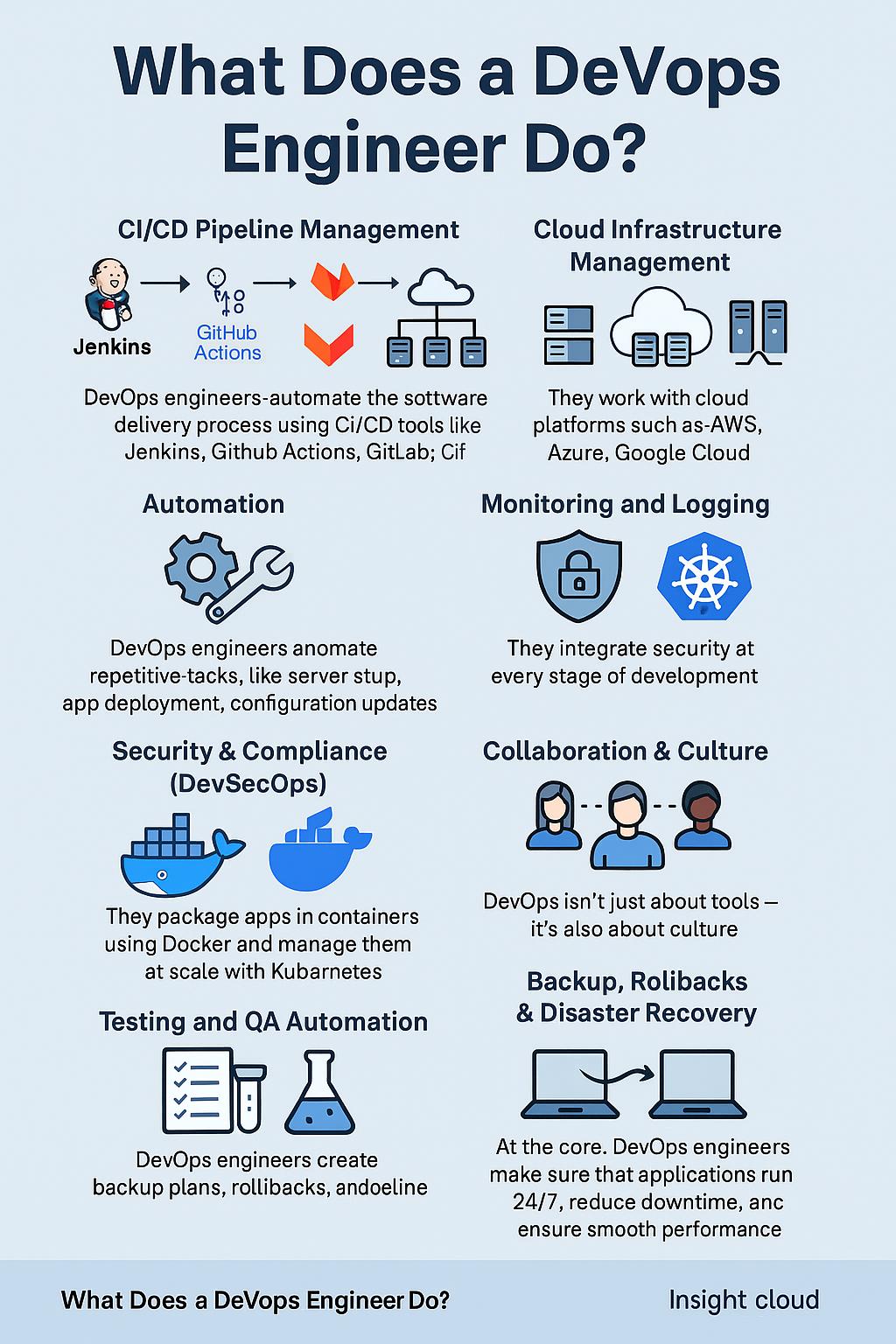
  • What Does a DevOps Engineer Do?

    In today’s fast-moving tech world, businesses need to deliver software faster, safer, and more reliably than ever before. That’s where a DevOps Engineer comes in. But what exactly do DevOps engineers do, and why are they in such high demand?

    This blog will break down the roles, tools, and responsibilities of a DevOps engineer in simple language, while also giving you expert insights into why this is a top career choice.


    Who Is a DevOps Engineer?

    A DevOps engineer is a professional who combines software development (Dev) and IT operations (Ops) skills to automate, streamline, and improve the software delivery process.

    They bridge the gap between developers and system administrators to ensure:

    • Faster deployments
    • Higher reliability
    • Continuous delivery of software

    Key Responsibilities of a DevOps Engineer

    1. CI/CD Pipeline Management

    DevOps engineers build and manage CI/CD pipelines (Continuous Integration and Continuous Deployment). These pipelines automatically test, build, and deploy code with tools such as:

    • Jenkins
    • GitHub Actions
    • GitLab CI/CD
    • CircleCI

    Why it matters: Code gets from developers to production faster, with fewer bugs.


    2. Cloud Infrastructure Management

    Most DevOps engineers manage cloud platforms like:

    • Amazon Web Services (AWS)
    • Microsoft Azure
    • Google Cloud Platform (GCP)

    They handle tasks like:

    • Setting up servers
    • Configuring databases
    • Managing networking
    • Scaling infrastructure automatically using Infrastructure as Code (IaC) tools like Terraform or CloudFormation

    3. Automation of Repetitive Tasks

    A big part of DevOps is automation. DevOps engineers automate things like:

    • App deployments
    • Server setup
    • Configuration updates

    Tools used:

    • Ansible
    • Puppet
    • Chef
    • Bash/Python scripting

    4. Monitoring and Logging

    Keeping an eye on systems is vital. DevOps engineers use monitoring and logging tools to:

    • Detect errors early
    • Ensure performance
    • Trigger alerts if systems go down

    Popular tools:

    • Prometheus
    • Grafana
    • ELK Stack (Elasticsearch, Logstash, Kibana)
    • Datadog

    5. Security Integration (DevSecOps)

    Modern DevOps includes security from the beginning — this is called DevSecOps.

    Security practices include:

    • Vulnerability scanning
    • Secrets management
    • Setting role-based access controls

    Popular tools:

    • Snyk
    • Trivy
    • HashiCorp Vault

    6. Containerization & Orchestration

    DevOps engineers use containers to bundle applications with everything they need to run anywhere.

    Key tools:

    • Docker (for containers)
    • Kubernetes (for managing and scaling containers)
    • Helm (for managing Kubernetes apps)

    7. Collaboration Between Teams

    DevOps is not just a job — it’s a culture. DevOps engineers:

    • Promote communication between dev and ops
    • Encourage transparency
    • Reduce silos

    This leads to quicker releases and higher-quality software.


    8. Testing and Quality Assurance

    DevOps engineers set up automated tests to catch bugs early in the software lifecycle.

    Test types:

    • Unit tests
    • Integration tests
    • Load tests

    Tools used:

    • Selenium
    • JUnit
    • Postman

    9. Backup and Disaster Recovery

    To prevent data loss, DevOps engineers create:

    • Backup systems
    • Rollback strategies
    • Disaster recovery plans

    10. Keep Everything Running Smoothly

    Ultimately, a DevOps engineer ensures that:

    • Applications run 24/7
    • Issues are fixed quickly
    • Releases happen safely

    They’re like the behind-the-scenes superheroes of tech.


    Why Companies Need DevOps Engineers

    • Faster time to market
    • Fewer bugs in production
    • Lower development costs
    • Better product stability and scalability
    • Happier customers and teams

    📈 Top Skills of a Successful DevOps Engineer

    SkillTools & Technologies
    Version ControlGit, GitHub, GitLab
    CI/CDJenkins, GitHub Actions
    CloudAWS, Azure, GCP
    ContainersDocker, Kubernetes
    AutomationAnsible, Terraform
    MonitoringPrometheus, Grafana
    ScriptingBash, Python

    Final Thoughts

    A DevOps engineer is essential in the modern software development lifecycle. They don’t just write code or manage servers — they enable businesses to scale, innovate, and deliver faster.

    If you’re considering a career in tech, becoming a DevOps engineer is a smart, high-impact choice.


    Keywords for This Blog:

    • What does a DevOps engineer do
    • DevOps responsibilities
    • DevOps tools and technologies
    • DevOps job description
    • Cloud and DevOps career
    • CI/CD pipelines explained
    • DevOps engineer in demand

    Next Steps

  • What Does a DevOps Engineer Do?

    Introduction

    You may have heard of a software developer or a system administrator. But what about a DevOps Engineer? Who are they? What do they actually do?

    In this blog, you’ll get a clear understanding of the role of a DevOps Engineer, why they’re important, and what tools and skills they use every day.

    Let’s break it down in a simple, professional, and easy-to-understand way.

    Who is a DevOps Engineer?

    A DevOps Engineer is someone who works at the center of software development and IT operations.

    Their main goal?

    Make sure code written by developers gets tested, deployed, and monitored smoothly without errors.

    They:

    • Help developers release updates faster
    • Automate everything from testing to deployment
    • Monitor systems to keep everything running

    What Does a DevOps Engineer Actually Do?

    Here are the core responsibilities:

    1. Collaboration

    They work with developers, testers, and IT teams to make sure everyone is on the same page.

    2. Automation

    They build systems that automate repetitive tasks like:

    • Code building
    • Testing
    • Deployment
    • Monitoring

    3. CI/CD Management

    They manage Continuous Integration and Continuous Delivery (CI/CD) pipelines. These are like smart machines that:

    • Take code from developers
    • Automatically test it
    • Deliver it to users without human effort

    4. Infrastructure as Code (IaC)

    DevOps Engineers treat servers like code. They use tools to:

    • Set up infrastructure with scripts (like writing instructions for computers)
    • Recreate environments quickly and safely

    5. Monitoring and Logging

    They set up systems that:

    • Watch how apps are running
    • Log any issues or crashes
    • Alert the team immediately

    6. Security and Backup

    They also add security checks and make sure backups are in place in case something goes wrong.


    Tools Used by DevOps Engineers

    AreaTools
    Code VersioningGit, GitHub
    CI/CDJenkins, GitHub Actions
    ContainersDocker
    OrchestrationKubernetes
    IaCTerraform, AWS CloudFormation
    MonitoringGrafana, Prometheus
    ConfigurationAnsible, Chef
    CloudAWS, Azure, GCP

    These tools help DevOps Engineers build, test, deploy, and monitor systems faster and better.

    Why Are DevOps Engineers So Important?

    Without them:

    • Deployments take longer
    • Bugs are harder to track
    • Developers and IT teams struggle to work together

    With them:

    • Everything is faster, safer, and smoother
    • Users get new features quickly
    • Systems are reliable, even during updates

    What Skills Do DevOps Engineers Need?

    • Basic coding (usually in Python, Shell, or Bash)
    • Strong understanding of Linux/Unix systems
    • Knowledge of cloud platforms (AWS, Azure, GCP)
    • Familiarity with CI/CD pipelines
    • Good communication and problem-solving skills

    Next Steps

  • DevOps Roadmap 2025: Step-by-Step Guide for Absolute Beginners

    If you’re new to DevOps and don’t know where to begin — this blog is for you. Whether you’re a fresher, a student, or switching careers, this step-by-step DevOps roadmap will guide you from zero to job-ready in 2025.

    Written in simple words, this blog gives you clarity on what to learn, how to practice, and where to build your portfolio.

    Step 1: Understand What DevOps Is

    DevOps = Development + Operations

    It’s a way of working where developers and operations teams work together to:

    Build code

    Test and deploy quickly

    Automate infrastructure

    Monitor everything

    DevOps focuses on automation, speed, reliability, and collaboration.

    Step 2: Learn the Basics of Linux

    You must learn how to use the command line.

    Learn:

    Basic Linux commands

    File system navigation

    Permissions (chmod, chown)

    Bash scripting

    Free Resource: LinuxCommand.org

    Step 3: Learn Git and GitHub

    Version control is key in DevOps.

    Learn:

    git init, clone, add, commit, push

    git branch, merge, pull requests

    GitHub for hosting code

    Free Resource: learngitbranching.js.org

    Step 4: Learn Scripting (Shell or Python)

    Scripts help automate repetitive tasks.

    Start With:

    Bash scripting (for Linux tasks)

    Python (for advanced automation)

    Project Idea: Write a script to backup files daily using cron

    Step 5: Learn CI/CD Concepts

    CI/CD = Continuous Integration and Continuous Deployment

    Tools to Learn:

    GitHub Actions (easy)

    Jenkins (popular)

    GitLab CI (powerful)

    Project Idea:

    • Auto-deploy your website when you push code to GitHub

    Step 6: Learn Containers (Docker)

    Containers let you package your app with everything it needs.

    Learn:

    What is Docker

    Dockerfile

    Docker CLI commands

    Project Idea: Dockerize a simple web app

    Step 7: Learn Container Orchestration (Kubernetes)

    Kubernetes helps run many containers easily.

    Learn:

    Pods, Deployments, Services

    YAML files

    Minikube for local testing

    Step 8: Learn Infrastructure as Code (IaC)

    You write code to create infrastructure.

    Tool: Terraform

    Learn:

    Create AWS EC2 using Terraform

    Provision S3 buckets

    Step 9: Learn Monitoring and Logging

    Tools: Prometheus, Grafana, ELK Stack

    Learn:

    Set up dashboards

    Collect system metrics

    Create alerts

    Step 10: Build and Showcase Projects

    Your projects are your resume.

    Project Ideas:

    CI/CD pipeline for a portfolio site

    Docker + Kubernetes app deployment

    Terraform AWS infra setup

    Monitoring setup with Grafana

    Tip: Push everything to GitHub and add a README.

    Bonus: Learn Cloud (AWS Free Tier)

    Most companies use cloud. Learn:

    EC2 (servers)

    S3 (storage)

    IAM (permissions)

    VPC (networking basics)

    Final Words

    You don’t need a degree or years of experience. You need:

    A learning plan

    Consistency

    Real projects

    Use this roadmap and start building. DevOps is one of the best-paying and high-demand skills in tech today.

    Keep it simple. Keep it practical.

    Next Steps